Your AI assistant may be leaving the interface work to the customer
When a customer changes their requirements, can they use the answer directly, or do they have to rebuild the comparison themselves?

Robert Scoble shared an OpenUI hotel-search demo on X yesterday, in a post marked as a paid partnership. He describes an agent responding with hotel cards, a budget slider and controls for narrowing the choice. The example interests me because it changes what the person receiving the answer can do next. They can adjust the search directly, with the options in front of them.
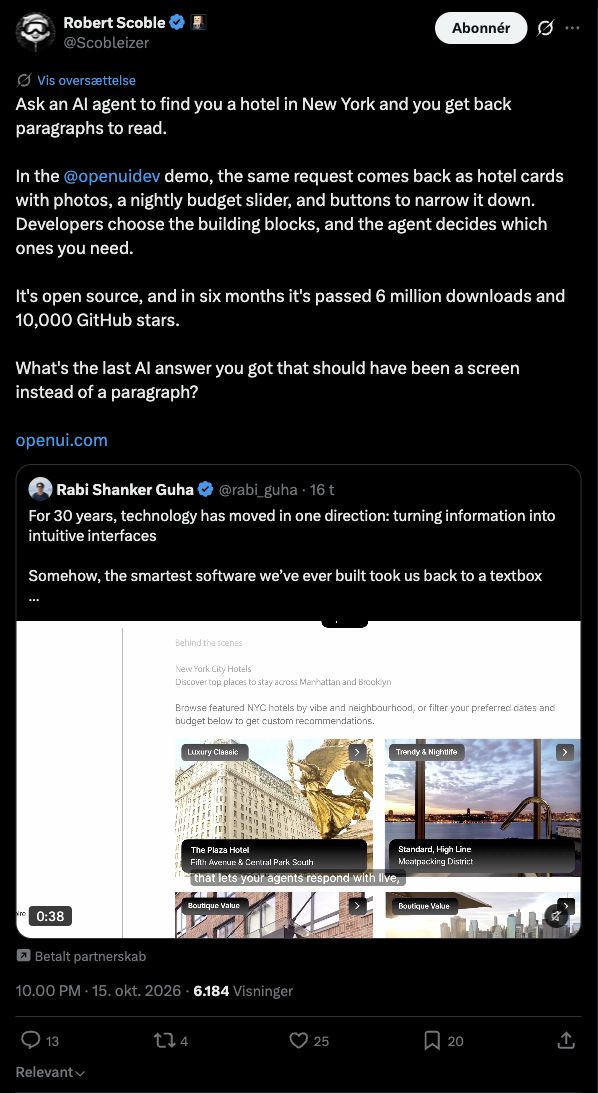
OpenUI's documentation explains the mechanism: developers provide a library of components, and the model selects and combines them for the request. An answer can contain an interactive comparison or form. That gives a company a different way to think about the assistant it puts in front of its customers. How much work does the customer still have to do after receiving a perfectly reasonable answer?
Imagine a business buying a maintenance agreement for its equipment. This is a hypothetical example. The buyer asks an assistant to explain the available plans. It returns a careful description of each plan, including the monthly price, equipment covered and call-out charges. All the information may be correct, yet the buyer still has to arrange it into something comparable. They might copy the details into a spreadsheet before they can make a choice.
Now the buyer wants to include another location. Some plans may charge for each site, while others depend on the number of machines. A paragraph about the additional location leaves them with more arithmetic and another version of the comparison to maintain. The company has made its information easier to ask for, but much of the work of using that information still belongs to the customer.
I would want the buyer to be able to change the locations and equipment in a shared comparison. The relevant charges should update together, using the actual pricing rules. If a plan requires a separate quote, that should remain visible. The buyer should be able to see which assumptions explain a total and return to the terms behind it. A useful explanation can sit beside those controls when a condition needs more thought.
The distinction also affects what we ask AI to do. OpenUI documents an approach where the model assembles the interface and an application runtime then handles interactions and tool calls. A changed selection does not inherently require the model to write another answer. For a business, that suggests a useful division of work: let the model help present the task while established calculations handle the commercial rules.
An existing comparison page might already do this well. In that case, I would want an assistant to bring the customer to the relevant comparison with their choices preserved. Generating a different screen earns its place when the request needs a combination that the ordinary page makes difficult. The value depends on the work it removes for the buyer. A changing layout can also make a familiar task harder to follow.
There is a commercial choice in the interface itself. A plan that looks inexpensive by monthly price may be expensive once call-outs are included. Which costs appear in the comparison, and which assumptions are selected when it opens, influence what the buyer notices. I would want those decisions examined with the same care as the assistant's words. A tidy card can make an incomplete comparison look settled.
For a company reviewing an AI assistant, I would follow a customer task through to the point where the customer can make a decision. Watch for the spreadsheet they open, the figures they copy and the repeated requests needed to keep the options comparable. Those steps tell us where the product is asking the customer to finish the interface. Then change a meaningful condition and see whether the comparison remains understandable and correct.
That is what I find useful in the OpenUI example. It gives us a way to ask more of an AI response than a helpful explanation. In the maintenance example, the buyer should leave knowing what each plan would cover for their equipment, which costs remain uncertain and what they need to clarify before choosing. The remaining work should help them judge the agreement, with the comparison already usable in front of them.