AI can help with outreach. The recipient still needs a reason to care.
What an observation about agent-powered emails makes me consider before getting in touch.

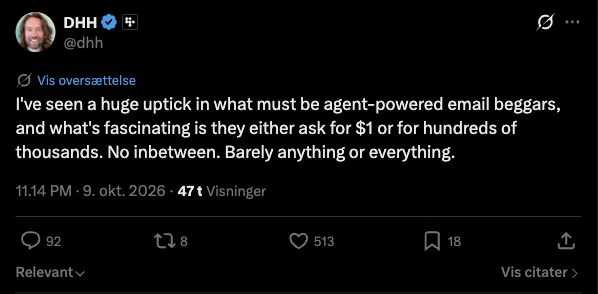
DHH posted that he had seen a large increase in emails asking for money, which he suspected were powered by agents. The amounts were either tiny or enormous. I cannot tell from his post how those messages were produced, but I recognise the commercial question it raises: when sending a request becomes easier, what makes receiving it worthwhile?
I work with AI and sales professionalization, so this interests me from both sides. AI can help investigate a company, make sense of what it finds and prepare a message. That gives us a chance to do better preparation. It also makes it very easy to turn a thin reason for getting in touch into a convincing paragraph.
A message can mention the right company, use the right vocabulary and sound personal while leaving the recipient with no useful reason to answer. Knowing someone's job title tells me where they sit. It does not tell me what they are trying to resolve, whether my help is relevant or why a conversation should happen now.
Suppose a company announces that it is expanding into another market. That is a real event. It might be a good reason for me to investigate further. It is not enough on its own to conclude that the company needs help with its sales organisation. Perhaps it already has an experienced team and a clear plan. Perhaps a different part of the expansion is taking all its attention.
AI can help me look into the announcement and the company's existing operation. I would want it to distinguish what the company actually says from what we infer. If we think sales preparation might be an issue, that remains a possibility to explore. Turning it into a confident statement about their problem would make the message less honest, however well it was written.
That distinction matters because the person receiving the message knows much more about their situation than I do. A small, accurate observation gives them something they can respond to. A long explanation of an invented problem gives them a reason to stop reading.
I would rather begin with a specific reason I thought of them and a clear explanation of what I could contribute. If I have to work hard to explain the connection, I may not have a strong enough reason to contact them yet. More research might help. Sometimes the sensible result of the preparation is to leave the message unsent.
This is where I find AI useful. I can ask it to investigate the context, challenge my assumptions and help me see whether there is a real connection between the situation and the work I do. That gives me more to judge than a polished draft. It can also reveal that someone else would be better placed to help, or that the timing simply does not make sense.
There is a similar question around the request itself. Asking for a meeting can feel like a small step to the sender. For the recipient it involves deciding whether to respond, finding time and working out whether the conversation is likely to be useful. The email should give them enough information to make that decision without asking them to discover the relevance for me.
A useful first message might point to a concrete part of the work and explain why it caught my attention. It should make the proposed conversation understandable. I do not need to present a complete diagnosis of their business, and I should not pretend to have one. I need to show that there is something specific worth discussing.
I am interested in what happens when we use AI to improve that preparation. We can spend less time assembling background information and more time deciding what the information means. We can check a claim before it becomes part of an introduction. We can compare different explanations for the same event and avoid choosing the one that happens to make our offer look most useful.
Sending more messages is an easy output to count. I would want to look at the conversations that follow: did the recipient recognise the situation, was the proposed contribution relevant, and did anything useful come from talking? A reply alone does not answer all of that. Neither does a larger outbound list.
DHH's observation is one person's account, not a measurement of all AI-assisted outreach. I still think it is a useful prompt to look at our own behaviour. If AI helps me prepare a message, the recipient should benefit from that preparation too. They should have less work to do to understand why I am there.
Before I ask AI to write the email, I want to be able to explain why I am thinking of this person, what I have actually observed and what I believe I can contribute. If those answers are weak, I would use AI to investigate them further. A better-written request can wait.