What happens to the software industry if years of work can be rebuilt in days?
The implications reach well beyond cheaper applications. They affect how long a company can earn money from what it has built.
REA brings reverse engineering into the agent workflow
A GitHub repository called REA, short for Reverse Engineer Anything, is now getting attention on X. It connects coding agents such as Claude Code and Codex to tools for inspecting software, including applications whose source code is not available. You can ask an agent to investigate how something works and follow the evidence into its implementation. REA repository and workflow, the discussion on X.
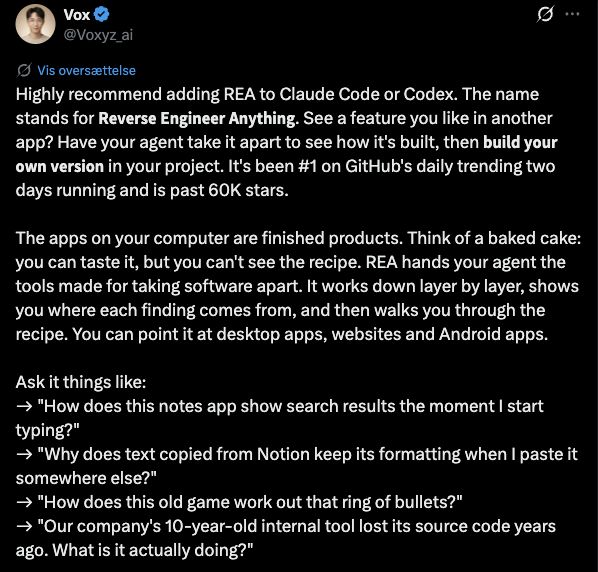
The agent can then use what it learns to help write and test an independent implementation. That brings understanding an existing product and building an alternative much closer together.
If years of software development can be reconstructed in a few days, I don't think we can build the same kinds of software businesses on that work anymore.
The implications reach well beyond cheaper applications. They affect how long a company can earn money from what it has built, the value of the head start it spent years creating, and whether investing in the next product gives it any more protection than the last one.
I don't know where that leaves the software industry. That uncertainty is why I think REA deserves attention far beyond the people who already work with reverse-engineering tools.
Open alternatives are appearing across major software categories
ArtCraft now has twelve public application projects. Seven target Adobe workflows; the others target Word, Excel, PowerPoint, AutoCAD and Pro Tools. They are attempts to build open implementations of large commercial applications used by consumers and businesses. ArtCraft applications, the discussion on X.
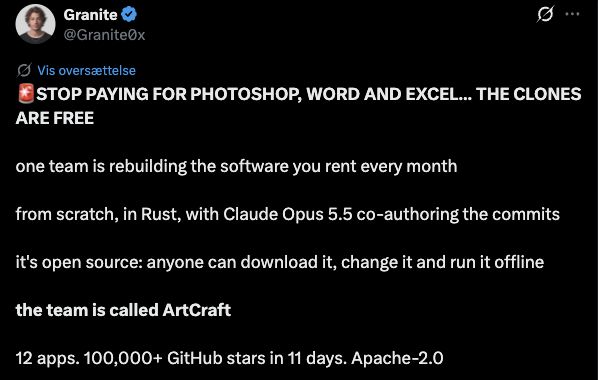
ArtCraft is a separate project from REA. WordCraft's rules require public file specifications and observation of Word's behaviour, and explicitly prohibit disassembling or copying the Word application. A public contribution credits Claude as a co-author. These are different methods, both relevant to whether established functionality can become easier to reproduce with agents. WordCraft's clean-room rules, an AI-credited contribution.
These projects are still early. WordCraft, GridCraft and DeckCraft describe themselves as alpha; CADCraft and SoundCraft as pre-alpha. Compatibility remains unfinished, including workbook problems and drawing content that can be lost when saved. They establish substantial open implementation efforts, not that a mature commercial suite has already been fully reconstructed in days. GridCraft's status, CADCraft's status.
The business question is what happens if the gap keeps closing, and reconstruction becomes dramatically faster than the original development.
Years of development may buy much less time
A company can spend years solving a problem, refining its product and making it dependable. That investment can be easier to justify when a competitor has to make a comparable effort to catch up.
Now consider a world where the finished product gives an agent enough information to help build a usable alternative in days. The original company's investment still happened. The period in which it can recover that investment may become much shorter.
That would affect how a software company plans its business. Development budgets, licence prices and expectations of recurring revenue depend partly on how long the product can remain worth paying for. A cheaper route to reproducing the functionality could disturb all of those assumptions.
Open source adds another consequence. Once an independent implementation is published under an open licence, other people can build on it. The incumbent could face several alternatives sharing the same foundation. ArtCraft's application code has permissive licences that allow reuse subject to their terms, with separate rights in branding and assets. WordCraft's licensing.
But the company creating the alternative faces the same question. If its improvements are just as easy to reproduce, how does it build a durable business around them?
Lower development costs could make it easier to start a software company while making the resulting company harder to defend. More products becoming possible does not tell us who will earn lasting returns from them.
The next business model is uncertain too
Support, implementation and operation can still have value. Their economics are different from licensing a product, though, and we do not know whether they can sustain the revenue and profits of today's software companies. Agents may change how much of that work customers need to buy as well.
For consumer applications, a usable open alternative could undermine the reason to keep paying a subscription. For enterprise software, the calculation includes integrations, security and the consequences of failure. Those requirements can slow a switch and give customers reasons to pay for dependability.
They leave open how much customers will pay, who they will pay, and how long a supplier can maintain an advantage. A company can deliver useful software and still find that the market will no longer support its current pricing or cost structure.
That is why I would be cautious about assuming that the winners will simply be the people who use AI to build the next replacement. They may be entering an industry in which the thing they just built becomes cheaper to reproduce almost immediately.
Rights remain, while the commercial assumptions can change
There are technical and legal limits. Inspecting a browser does not expose a vendor's private server code or data. An alternative to a hosted enterprise service still has to implement the service and operate it. REA's browser scope.
Copyright also remains. EU software law protects the expression of a program and sets conditions for observation and interoperability work. Being able to understand software does not automatically create a right to copy and distribute it. EU Software Directive.
Those boundaries matter. They do not settle what happens to a business when customers can obtain a lawful, useful alternative much more cheaply than before.
For me, the difficult question is how much of the software industry's economics depends on reconstruction taking a long time. If that protection weakens across major categories of enterprise and consumer software, the effects could reach well beyond individual products to decisions about funding development and buying software companies.
I don't have a confident prediction for what replaces those economics. Before I accepted a claim about years of future software earnings, I would want to understand what keeps the functionality worth paying for when reproducing it becomes easier. The amount of work already invested would give me very little reassurance.