What is a Proof of Value?
A Proof of Value tests whether a product delivers a business result for one customer before that customer buys. Of eleven published sales-side definitions, two require the person who holds the budget to agree before it starts.
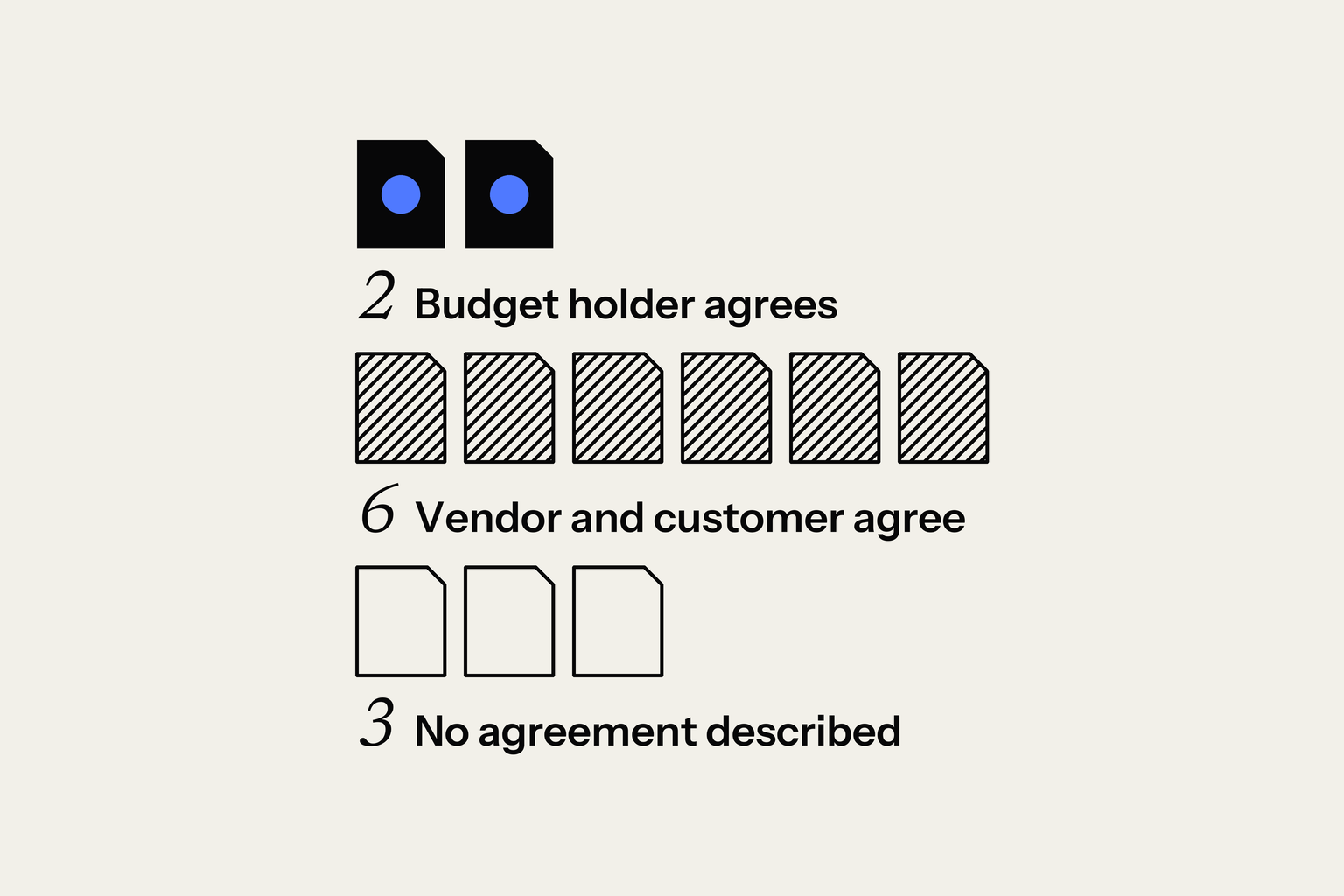
In software sales, a Proof of Value (PoV) is a stage before a purchase in which a vendor and a customer test whether the product delivers a business result for that customer. Ten of the eleven sales-side definitions read for this article agree on that. The eleventh uses the name for a business case that the seller builds from figures.
The eleven differ on whose agreement the proof needs before it starts, and two of them require the person who holds the budget to agree. My own definition stands with those two. On my page From Proof of Concept to Proof of Value, a Proof of Value tests whether the product delivers the business outcomes the economic buyer has agreed to.
The same name outside sales
Nineteen pages that define the term were opened and classified for this article on 12 October 2026, and they use the name for three things. Eleven describe a stage in a sale that a vendor goes through with one customer before a purchase. Tenable, NHI Management Group and FullEnrich write for a buyer who is evaluating a product for its own organisation. Boldare, coscomp, Humanperf and Mailchimp describe a company's own check that a product, an idea or a technology is worth developing.
ValueCoders mixes the last two meanings. It presents the term as a way to validate a business idea early in software development. The three examples under its definition are companies testing a product they are taking in.
So a request for a Proof of Value can carry any of the three meanings, and a customer who asks for one may mean the buyer's. On NHI Management Group's page the test belongs to the buyer. The page names a scripted demo as the most common misapplication, with the data, the test conditions and what counts as success all in the vendor's hands.
Eleven definitions from the selling side
A page is counted here as requiring the budget holder's agreement only if it says that this person must define success, agree to the criteria or commit to a next step before the proof starts. Naming that person, keeping them informed or writing criteria to suit them is not counted.
By that rule two pages require it, six have the vendor and the customer agree without requiring it, and three describe no agreement before the start. One of the three is FirstPitch, whose Proof of Value is a business case that the seller builds from the customer's baseline figures and from benchmarks. None of its five steps runs the product.
| Publisher | Agreed before the start | The person who holds the budget | Counted as |
|---|---|---|---|
| Steerlab | Agreed before the start Vendor and buyer put in writing the business problems, the metrics, the environment, the timeline and the resources each side commits | The person who holds the budget The economic buyer must be willing to "define what success looks like in business terms before the evaluation starts"; otherwise the page does not call it a Proof of Value | Counted as Budget holder agrees |
| WinsAbove | Agreed before the start Success criteria are defined upfront and owned by the buyer, and both sides sign off on how the results are measured | The person who holds the budget An executive sponsor, the person with authority over the budget, has committed to go ahead commercially if the criteria are met | Counted as Budget holder agrees |
| CloudShare | Agreed before the start Both sides settle upfront what success means and which metrics show it | The person who holds the budget The criteria are meant to suit those who approve the budget, and the results go to budget holders and executives | Counted as Vendor and customer agree |
| B2BLead | Agreed before the start The metrics that count as success are put in writing, and each side signs off on them and on the way they are measured | The person who holds the budget The criteria should name outcomes the economic buyer cares about, and the champion takes the result to budget approval | Counted as Vendor and customer agree |
| Big Business Agency | Agreed before the start Seller and buyer talk through what success means for the buyer and set shared objectives | The person who holds the budget Names no budget holder; every stakeholder in the buying group is to be involved from the start | Counted as Vendor and customer agree |
| GitLab | Agreed before the start GitLab and the customer settle the problem or outcome, the success criteria and the decision that follows, and the customer acknowledges the plan | The person who holds the budget A named executive approver is required before the kickoff of an enterprise evaluation, and the executive buyer gets a weekly report and the readout | Counted as Vendor and customer agree |
| Vivun | Agreed before the start The evaluation plan is built together with the prospect, including the outcomes that count as success | The person who holds the budget Names no budget holder; it speaks of business decision-makers and C-suite executives | Counted as Vendor and customer agree |
| FlowFuse | Agreed before the start Success criteria and plan are agreed with the customer before the start, and the customer gives its formal agreement to the proof at kickoff | The person who holds the budget Its PoV Workbook records the sponsor and the budget holders at the outset; economic buyer alignment is listed after a successful proof | Counted as Vendor and customer agree |
| TestBox | Agreed before the start No agreement is described; the page advises involving stakeholders from the beginning so that their expectations are understood | The person who holds the budget Names no budget holder; it speaks of stakeholders, decision-makers and executives | Counted as No agreement described |
| An article on LinkedIn | Agreed before the start No agreement is described; its steps begin with the customer's pain points and the measures that matter to the customer | The person who holds the budget Names no budget holder; it speaks of decision-makers and executives | Counted as No agreement described |
| FirstPitch | Agreed before the start No agreement is described; the seller builds a business case from the customer's baseline figures and from benchmarks, and the first two days are a discovery call that fixes the baseline figure and the CFO's decision criteria | The person who holds the budget The CFO is the reader the case is written for; the champion forwards it, and on the last day the seller schedules a review with the CFO or an executive | Counted as No agreement described |
How firm the count is
Other rows come close to the line. CloudShare and B2BLead write that the criteria should fit what the people approving the budget care about. FirstPitch has the seller settle the CFO's decision criteria in a first discovery call.
Three rows go a step further and have the person who approves named before the start. B2BLead tells the seller to find out who needs to approve once the results are in. GitLab requires a named executive approver before the kickoff of an enterprise evaluation, and FlowFuse's workbook names the sponsor and the budget holders at the outset.
None of these pages says that this person must agree. A reader who counts those three anyway gets five of eleven.
Most of the pages come from two DuckDuckGo searches on 12 October 2026, for "what is proof of value" and "what is a proof of value in sales". Their first ten results held sixteen different pages. Three more were added: the handbooks of GitLab and FlowFuse, which describe how each company runs its own proofs, and Vivun's sales glossary.
That selection was fixed before any page was classified. Another eleven pages were opened and left out because they fall outside it. All three added pages fall in the group where vendor and customer agree, so the search results alone give two of eight, against two of eleven with them.
Eleven sales-side pages are a small sample, and the count describes those pages only. It is also a count of what definitions say. It cannot show what happens to a proof that is run without the budget holder's agreement. That part is an argument.
Steerlab writes that without the economic buyer the results have no audience that can decide. At WinsAbove a successful proof without an executive sponsor ends as a report left in an inbox. My own page says that without the economic buyer's agreement the proof has no business case to serve.
What GitLab's handbook said in July
GitLab's row would have been counted differently in July. The handbook is kept in a public repository, where the page's file as it stood on 24 July 2026 can still be read. To qualify a Proof of Value, that file required the champion and the economic buyers to agree on the success criteria, and it gave a sign-off as an example.
The page was rewritten in September. The text read for this article calls itself a working draft and was last modified on 15 September 2026. It does not use the term economic buyer and uses the term executive buyer eleven times. An executive buyer may be the same person under another name, so this is a count on two dated texts and says nothing about how GitLab runs its evaluations.
What to ask before any setup
Someone who has been asked for a Proof of Value this week can take one question from the table and put it before any environment is set up. Who on the customer's side has agreed to what this proof must show? The eleven pages allow three answers under the same name. The customer's team has agreed to the criteria, the person who holds the budget has agreed as well, or nothing is agreed yet.
My page gives the second answer and lists what else is agreed before a Proof of Value starts. A CRO can put the same question to the company's own written definition. Does it say who agrees before the start, and is the person who holds the budget among them? GitLab's handbook shows that the answer can change in a single rewrite.
Who reads the result
The eleven pages do not share a name for the result. Among the names are a business case, a results report, a formal review, a readout and a sign-off against the criteria. They also differ on who takes the result to the person with the budget.
On six pages someone inside the customer carries it onward. B2BLead, Vivun, WinsAbove, TestBox and FirstPitch name the champion. FlowFuse's workbook names the sponsor or champion, who takes the business case to the budget holders.
Steerlab and GitLab have the vendor present the result. Steerlab ends the proof with a formal review that the economic buyer attends. At GitLab the account executive presents the business value and a commercial recommendation to the executive buyer. CloudShare, Big Business Agency and the LinkedIn article leave open who takes it there.
GitLab splits its readout between two roles. The account executive's part ends in an explicit ask with four possible answers: proceed, expand, remediate or stop. The solutions architect gives the technical readout, with the success criteria, the evidence, the result of each use case, the product gaps and a recommendation.
Spendflo's template for a buyer running a proof of concept ends in a one-page memo to a named decision owner, who decides between buying, running a pilot and stopping. It tells the buyer to set each failed criterion beside the vendor's proposed fix, since these end up as terms in the contract.
On my page three people read the result. The economic buyer reads a Proof of Value for the business case, the deal champion for whether the right tool is being put in place, and the technical champion for how the product works in detail. The Sales Engineer prepares the result for all three, while the account executive runs the commercial path around it.
GitLab's two parts match two of those three readers. The account executive's part answers the economic buyer's question about the business case, and the solutions architect's part answers the technical champion's question about how the product works.
That leaves the deal champion. Six of the eleven pages hand the result to a champion to take onward. WinsAbove has the champion present the results report upward as the business case, and FirstPitch asks for a one-page case that the champion can forward unchanged to the CFO.
Taking the result onward is a different job from reading it. For FirstPitch, a champion who is already convinced that the product works is a sign that the deal calls for a Proof of Value. None of the eleven pages describes a champion who reads the result to judge whether the tool is the right one.
Whoever prepares the result can build most of it from these pages: business value and an explicit ask for the economic buyer, a technical readout for the technical champion, and one page a champion can forward unchanged. The part for the deal champion's own question has to be written from what the proof showed.
Sources
- What Is a Proof of Value (POV)? How It Differs From a Proof of Concept. Steerlab, 6 May 2026.
- Proof of Value. WinsAbove, 15 June 2026.
- What is Proof of Value (POV)? CloudShare, undated.
- B2B Proof of Value (PoV): What It Is and How It Differs from a Proof of Concept. B2BLead, 27 June 2026.
- Using Proof of Value (PoV) to Win Bigger Enterprise Deals. Big Business Agency, 29 October 2024.
- Proof of Value (POV). The GitLab Handbook (last modified), 15 September 2026.
- Evaluation: Proof of Value. Vivun, undated.
- Proof of Value. FlowFuse Handbook, undated.
- PoV Workbook. FlowFuse Handbook, undated.
- POC vs POV: Framework for Choosing Wisely and Implementing Effectively. TestBox, 28 August 2024.
- Proof-of-Concept or Proof-of-Value in Pre-Sales: What is the Best Approach? Stephen H., an article on LinkedIn, 29 June 2023.
- Proof of Value vs Proof of Concept: The Definitive Guide to POV vs POC in B2B SaaS (2026). FirstPitch, 23 June 2026.
- Proof of Concept (PoC) vs. Proof of Value (PoV): What Do They Mean for Your Business? Tenable, 11 March 2019.
- What Is Proof Of Value? Definition & Examples. NHI Management Group, 30 July 2026.
- Proof of Value: A Comprehensive Guide to Understanding and Implementing PoV in Business. FullEnrich, 8 November 2023.
- What exactly is a "proof of value"? coscomp GmbH, 25 May 2023.
- POC, POV, POT: definitions, differences and implementation. Humanperf Software, 9 October 2023.
- POC vs. POV: What’s the Difference? Mailchimp, undated.
- Difference Between Proof of Value & Proof of Concept. ValueCoders, 20 December 2024.
- What is a proof of value in digital product development? Boldare, 20 October 2022.
- Proof of Value (POV), the handbook page's source file at commit 3c1e325d. GitLab, public handbook repository, 24 July 2026.
- Commit 3c1e325d: Remove broken university.gitlab.com links from handbook. GitLab, public handbook repository, 24 July 2026.
- Commit 5c2f88bd: Big Draft rewrite of POV process. GitLab, public handbook repository, 8 September 2026.
- Proof of Concept Template. Spendflo, 7 October 2026.
Facts last checked on 12 October 2026.