Your AI strategy may be based on an outdated experience
Before deciding what AI is worth to your company, examine the task, the setup and the work left for a person.

Andrej Karpathy described a widening gap in how people understand AI in a post on 11 October. Casual chatbot users and people using advanced systems professionally can have very different experiences. He also points out that the capabilities are uneven, with particularly strong progress in areas such as programming where results can be checked.
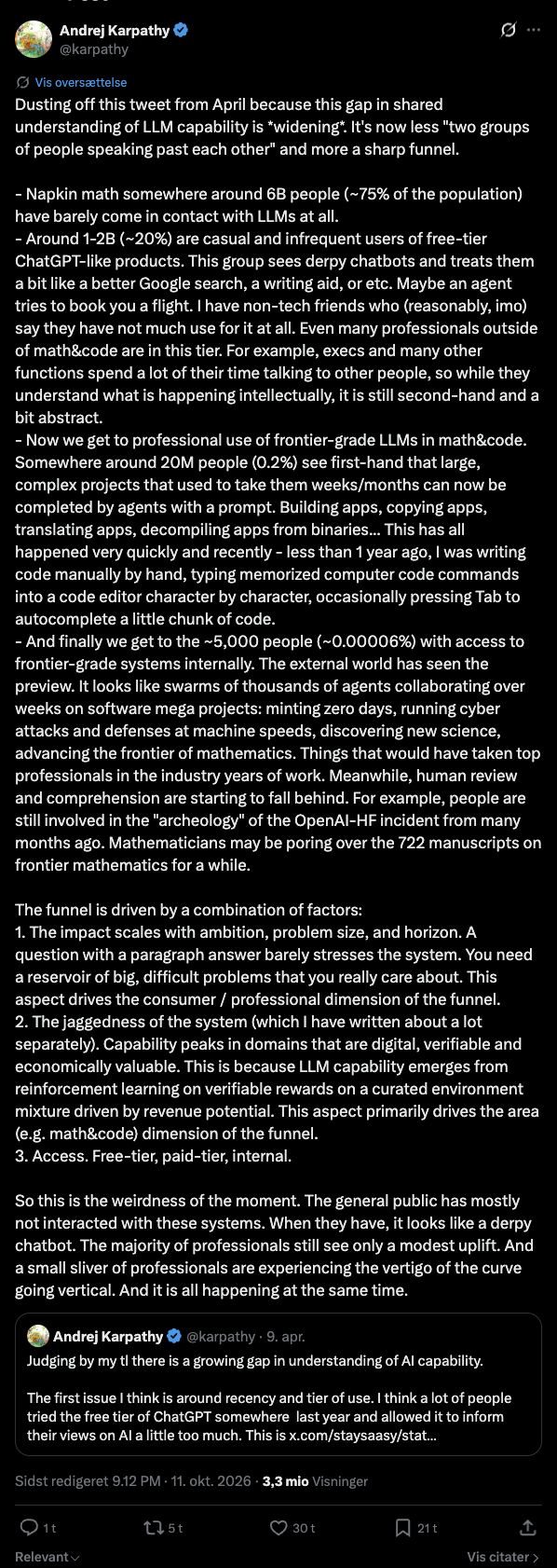
I think this creates a problem for company leaders. When someone says they have tried AI and found little use for it, I would want to know what they actually tried. Which system? On what task? With what information? A short conversation with a chatbot tells us something about that conversation. I would be careful about using it to decide how much of the company's work AI can help with.
The same applies to an impressive demonstration. Watching someone else's agent complete a difficult task does not establish that it can do the work your company needs. Their task may be easier to verify, their setup may include information yours lacks, and you may be seeing the successful attempt. There is a lot of room between dismissing AI after a poor chat and approving an investment after a good demo.
I would begin with a piece of work that matters enough to test properly. It should have a clear purpose and a result someone in the company can judge. Making an AI assistant write a cheerful email may be useful, but it gives me little evidence about whether it can help prepare a difficult customer decision.
Suppose a sales team wants to investigate a prospective customer before a first meeting. This is a hypothetical example. The task could be to identify which public developments at the company are relevant to the conversation, explain why, and show the sources. That gives the person reviewing the work something to examine beyond whether the briefing sounds confident.
The agent would need the purpose of the meeting and a description of what the sales team can help with. Without that, it may produce a competent company summary that does very little for the conversation. If those inputs are missing, I want to know that before deciding whether the system is capable of useful preparation.
The brief should also describe what the agent is allowed to do. For this test it could use public information and prepare a briefing for review. It would not need permission to contact the customer. That makes the trial manageable and lets us examine the work before any of it reaches someone else.
The test needs a current system that can attempt the whole task, with access appropriate to the agreed boundaries. I would record the actual setup so the result is interpretable. Otherwise, two people can say they tested AI while having tested substantially different things. We need enough detail to understand what an improvement or a failure belongs to.
The review should include the work left for the human. Can the sources be opened? Do they support the conclusions? Which important question remains unanswered? A briefing that takes longer to verify than to prepare yourself may be a poor choice, even if its first version arrived quickly. The reviewer should be able to say where the help was useful and where it created more work.
If the result is weak, I would examine the failure before extending the conclusion. Perhaps the information was insufficient, the task was poorly defined, or the system could not do it reliably. Those explanations lead to different decisions. There may be a sensible revision to try, or a good reason to leave that responsibility with a person.
If the result is strong, I would repeat the test on another suitable customer before treating it as a dependable way of working. A single successful case is a reason to investigate further. It does not tell me how often the system will miss something important or how much supervision it will need across different assignments.
Karpathy's point about uneven capability belongs in the business decision too. Evidence that an agent performs well on a task with a clearly checkable result should not automatically become evidence about work that depends on judgement or another person's reaction. A system can be useful in one part of a process and unsuitable for the next.
Before investing, I want to see what happens to the total effort and quality when the system becomes part of the work. The trial should make it possible to name the responsibility it can help carry and the decisions a person still needs to make. If we cannot describe that division, I would want more evidence before expanding the arrangement.
For the sales team, that might mean using the agent for public research while keeping the judgement about what to say to the customer with the salesperson. The next review can examine whether that division of work is still useful, with the setup and the result available to inspect.