Pieter Levels is changing what he sells as software gets easier to copy
A $1 community and an annual data product priced in thousands of dollars show one founder reconsidering where his businesses can earn money.

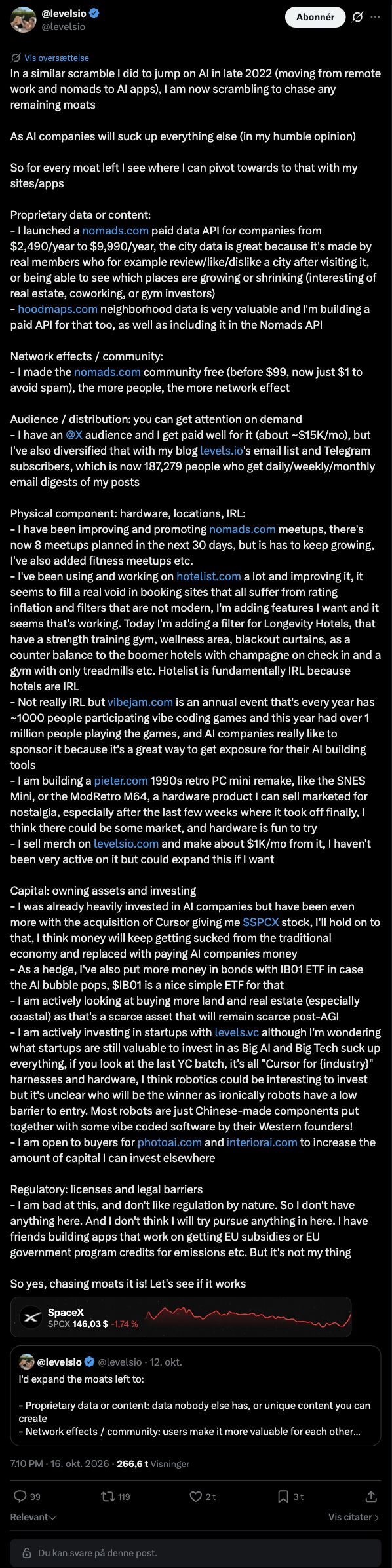
Pieter Levels wrote on 16 October that he is looking for ways to protect his businesses as AI makes more software easier to build. Two of the changes he describes caught my attention. He has reduced the price of his Nomads community from $99 to $1, which he says is there to discourage spam. At the same time, he has launched a data API for businesses, with annual prices from $2,490 to $9,990.
The Nomads API page confirms those prices. It offers city information that other companies can use in their own products, including member ratings and reviews alongside information such as living costs and weather. These are different customers paying for different things: an individual joins a community, while a business pays to use a maintained collection of information.
I think that is a more interesting response to cheaper software than simply trying to build the next application faster. Levels is examining what his existing businesses have accumulated and whether someone else will pay for it. The software gives people a way to participate, while some of the information that participation produces can support another product.
There is a possible commercial logic in lowering the entry price. If more people join, use the service and contribute useful observations, the information available to the business could improve. A company using that information might then have a reason to keep paying for access. That would give Levels a reason to make participation easier, even as he charges another customer much more. This is my reading of the combination, not evidence that the pricing change has already produced those results.
It also makes the competitive question more specific. Someone can build a similar interface without acquiring the people who use Nomads or the history of what they have contributed. Reproducing the screens does not automatically reproduce that source of information. For a competitor, the work includes persuading people to participate and finding a reason for them to keep doing so.
That does not make every field in a database a competitive advantage. Weather and basic city facts can come from other sources. Even member contributions need to be useful enough for a business customer to care. I would want to understand which information is difficult to obtain elsewhere, how reliable it is, and what decision or product it helps the customer improve. Calling the collection proprietary would leave those questions unanswered.
There is a second dependency too. The people contributing need a reason to remain. A low joining fee can remove a barrier, but it does not by itself make a community worth visiting. If members stop contributing, or if the useful contributors leave, the business has a problem that more efficient software development cannot solve on its own. The product serving the members still has to earn their attention.
The difficult commercial decision is that the part you used to charge for may become the part you need more people to use. A community entry fee brings in money directly. Reducing it means giving up some of that income in the hope that wider participation supports something else. A founder has to decide how much of the existing model to protect while trying to establish the next one.
The API also lets the information travel beyond the original website. Nomads markets it for use in another app or AI agent. A business customer could build its own experience around the data, with no need to reproduce the community that helps supply it. That creates a possible division of work: one company maintains the information, another brings it to a different audience. The first company then needs to be worth paying even when its own interface is out of sight.
There is no guarantee that the data will escape the same pressure as the application. Other providers may offer an adequate substitute. A buyer may find that general information is enough, or that member opinions do not improve its product enough to justify the fee. The relevant advantage has to survive a customer's comparison with those alternatives. It cannot rest entirely on how much effort went into collecting the information.
Levels' changes are a concrete attempt at this kind of adjustment. The prices and the offer are visible. Whether enough businesses will buy the data, whether the community will supply useful new contributions, and whether the economics will hold are still open questions. I would watch those relationships before declaring that he has found a durable defence against AI competition.
I think software founders need to take that uncertainty seriously enough to reconsider what they charge for. Levels is lowering a barrier for one group while asking another group to pay thousands of dollars for a different use of the same business. That involves changing the offer, the buyer and the economics around the product. A company can keep improving its software and still have to make that much larger decision.