Executive advisory for founders and CEOs: a regular sparring partner on the company’s decisions and direction
We work on what is on your table: the next market, a senior hire, the plan the board expects, a product bet, a price. You hear my view and the experience behind it, and I stay close enough to follow what changes between our conversations.
At Leapwork I was part of the leadership team, built the global Sales Engineering organisation from the ground up and led broader commercial professionalization across the go-to-market organisation.
- Finance
- Product
- Technology
- Sales
- Operations
Founders and CEOs of B2B technology companies
Executive advisory is for founders and CEOs who want to test company decisions with someone outside the business.
- Sales still depend heavily on the founders and a few experienced people.
- The company is entering a new market, moving upmarket, or getting a new owner or leadership team.
- The board and the investors expect a plan, and you want to test it with someone outside the company first.
How executive advisory works
You bring the decision and the material behind it. Afterwards, you get a short decision note.
Before
You send the decision, the options you see and the material behind them.
During
We sort what you know from what you assume, and look at the consequences for customers, economics, technology and the organisation. I say what I would do and why, what worries me and what I would test first. You decide.
After
You get a short decision note with the assumptions, options, consequences and chosen actions.
Between conversations
A customer escalates, an investor calls, a candidate says yes: you can send me the question when it happens. We agree together how often we talk.
You bring the decision.
We look at the consequences.
A short decision note.
- You
- Me
- A decision
The work can be direct sparring with the CEO or involve selected leaders when their perspective is relevant to the decision.
What stays with you
You keep the decisions, and the credit for them.
- Your relationships with the board, the investors and the team. I speak with them when you ask me to.
- What we discuss stays between us.
- When the work needs more than our conversations, we scope it as a separate assignment.
Where the experience comes from
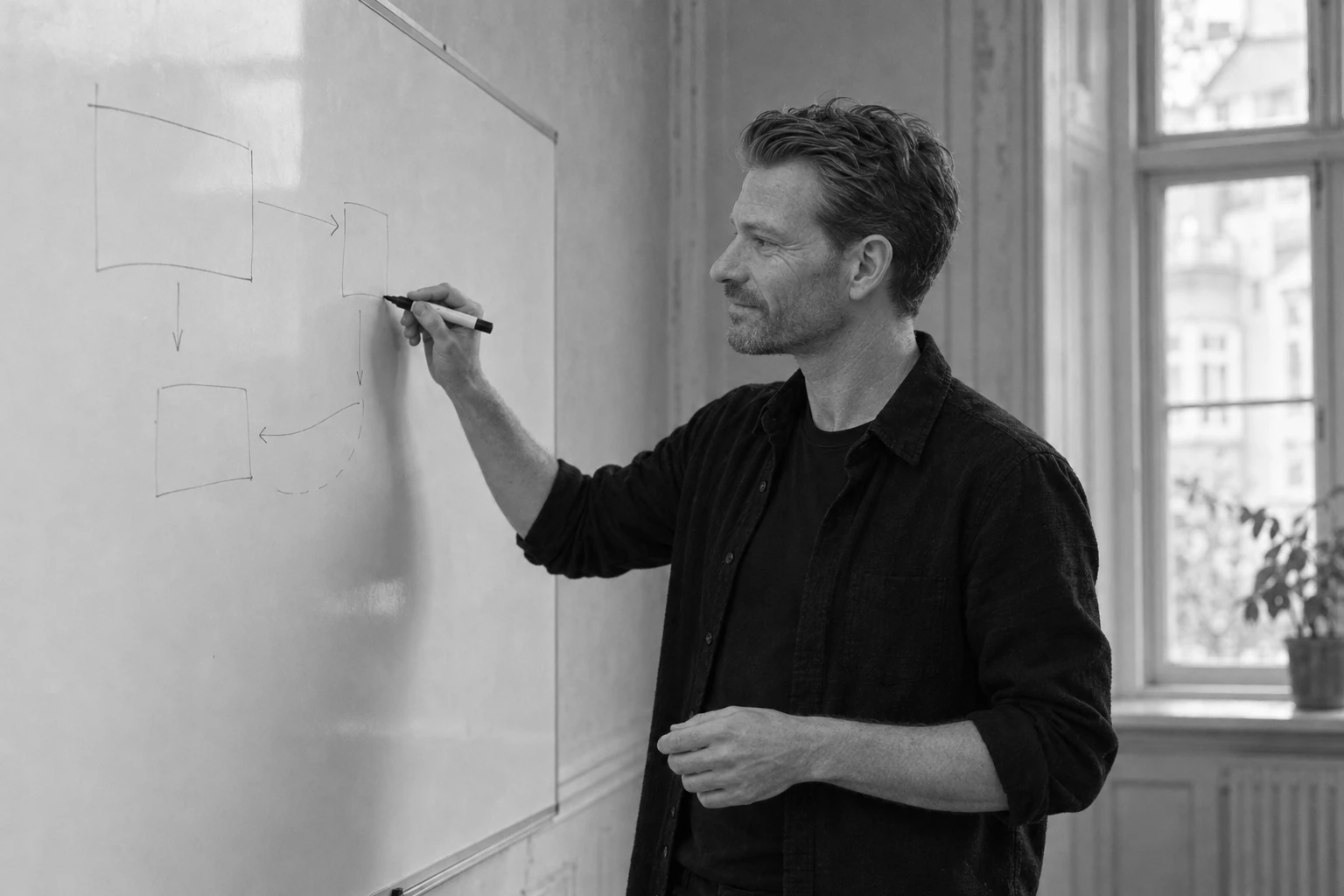
I am also a founder and CEO myself, so I know the part of the job the rest of the company rarely sees.
In longer engagements with Two Hundred, ZAGENO, Relesys and Groundley, I helped build business value narratives, introduce a shared sales language, enable sales organisations, hire people and coach leaders and teams through the implementation.
For the past two years my full focus has been on AI, and I have worked hands-on with current AI systems.
In the first conversation I want to understand what kind of company you are trying to build, where you have seen real demand, and what needs to be true for the product, distribution and delivery to become one coherent business. We agree a first period and look at it together at its end.
Tell me about the decision on your table.
A few lines are enough.