What AI interviews could tell you about a lost deal
A buyer may be able to explain something a product comparison cannot. The interview needs to uncover the work and responsibilities behind the choice.
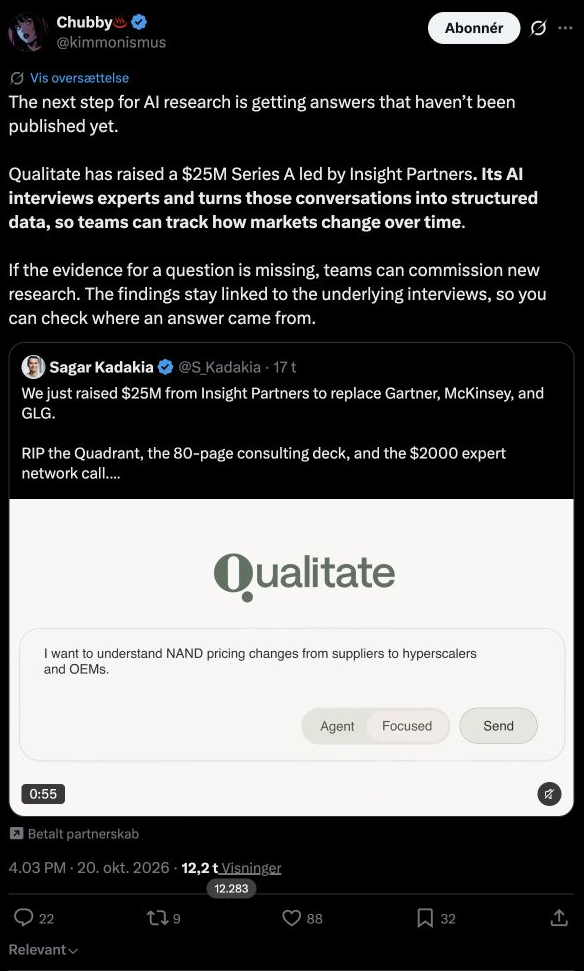
The X post that brought Qualitate to my attention yesterday is marked as a paid partnership. The company describes an AI interviewer that speaks with people from its expert panel and asks follow-up questions. Win/loss research is among its stated uses. That interests me because it gives AI a way to collect information that the people making a buying decision may never have published.
I can research a competitor’s product and understand how it presents itself. That leaves plenty unanswered about a particular deal. Why did the buyer begin looking? What made staying with the existing arrangement difficult? At what point did our proposal stop making sense to them? The people involved in the decision may be able to explain things a product comparison cannot.
For a win/loss project, I would want to reconstruct what happened from the buyer’s side. A general opinion about a supplier is useful for some questions. Understanding a lost deal requires someone who was involved in that decision, with enough context to describe their own part in it.
Consider a hypothetical enterprise buyer who chose a more expensive competitor. Our team might conclude that the competitor had a feature we lacked. An interview could instead reveal that the buyer was worried about the work of changing systems. The chosen supplier had made that work easier to understand and take responsibility for. Those explanations would lead us to change different things about our offer.
I would begin by asking the buyer to walk through the decision. What was happening when the project started, and what did they try first? If they say implementation was a concern, I want to know when it became a concern and who had to deal with it. A follow-up about the actual work can tell us more than asking whether our implementation offer was good enough.

The respondent’s role matters here. Someone who evaluated the product can explain that evaluation. They may have had little involvement in the final discussion about funding or responsibility. I would keep that limit with their answer and look for the person who could explain the missing part. Several interviews with the wrong participants could still leave us guessing about the decision.
Qualitate’s published workflow makes the interview guide and target expert profiles available for approval before the project starts. I would use that step to check whether the research could answer our particular question. Asking people who recently participated in a purchase is a different assignment from asking a broad group of industry experts which products they like.
The company also describes findings backed by the underlying transcripts. For this kind of research, I would want to follow a recommendation back to the interview that supports it, including the question that produced the answer. If two buyers describe different problems, the difference belongs in the findings. It may reflect their situation, the role they held or something we have yet to understand.

A product description does not establish how well an AI interviewer will handle those distinctions. Before relying on it for an ongoing win/loss programme, I would examine complete interviews and the conclusions drawn from them. Did the follow-ups help explain the sequence of events? Did the summary preserve what the participant knew and what remained unanswered? That is work the commissioning team still needs to own.
What I find promising is the possibility of making these conversations a more regular part of how a sales organisation learns. When a buyer’s account shows that the problem was the responsibility around implementation, the next action may be to change how we scope and explain that work. A better competitor summary would have left that question open.