5 resources for practising enterprise discovery with your team
Choose the resource that fits the part of discovery your team needs to practise.

A useful discovery session leaves the account team able to explain the customer's problem and decide what to investigate next. When the notes contain a long list of requirements, it is worth asking whether the business consequence is equally clear.
These five public resources address different parts of that work. The selection includes a reading collection, practical checklists and explanations of established frameworks. Use the descriptions to choose a practice task for an account executive and Sales Engineer working on a current opportunity. The practice suggestions below are starting points for your team.
1. Force Management's discovery resources: prepare the conversation
Force Management's discovery resource collection brings together guidance on preparation and discovery as an ongoing process. Its preparation section asks sellers to consider the outcome of the discussion, the customer's business outcomes, metrics, requirements and the people involved.
Before an upcoming meeting, have the account executive and Sales Engineer explain what they need to understand from the person they will meet. Write down the business decision the conversation should help with and the gaps in the team's current understanding. Then examine the questions you planned to ask. Would the answers help close those gaps?
This is a useful starting point when preparation consists mainly of a list of product questions. The collection also points to other articles and a podcast; reading the page gives you an entry point, with further material to choose according to your need.
2. Great Demo!'s planning checklists: examine what discovery has produced
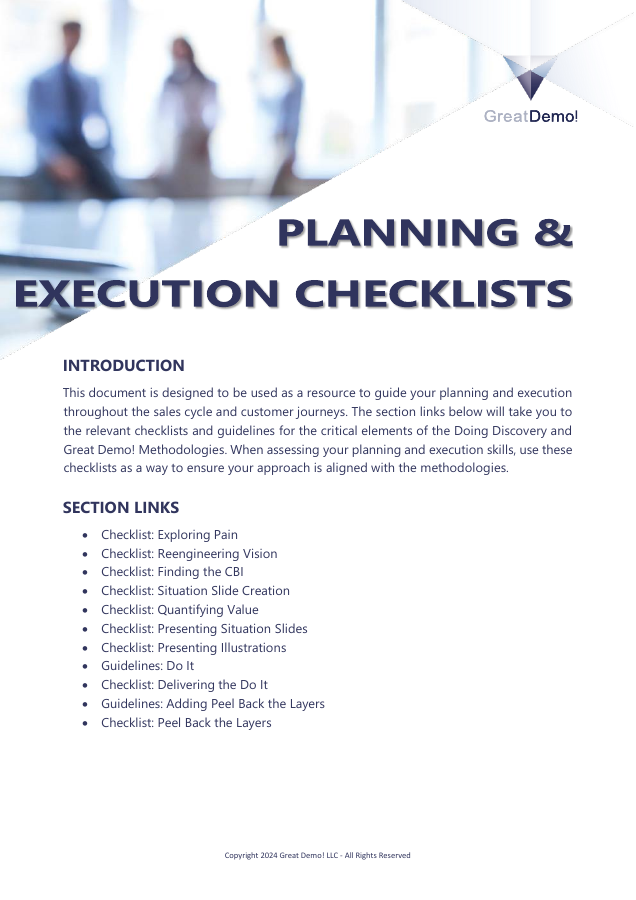
The Planning & Execution Checklists from Great Demo! include sections on exploring pain, finding the critical business issue and creating a Situation Slide. The document connects the customer's circumstances to the capabilities, value and timing discussed before a demonstration.
Use the Situation Slide creation section to review notes from a real conversation. Can the team explain the business issue in the customer's language? What connects the requested capability to that issue? Whose timetable are you working towards? A blank or vague answer gives you something specific to clarify with the customer.
The document is most useful here as a check on the understanding you bring into a demo. Keep the original checklist available and refer back to its guidance as you practise. A completed slide still needs the customer's confirmation, particularly when priorities or participants have changed.

3. Winning by Design's SPICED explanation: compare the team's understanding
Winning by Design's public SPICED explanation sets out Situation, Pain, Impact, Critical Event and Decision. The elements cover the customer's circumstances, the consequences of the problem, the reason timing matters and how the customer will choose.
Ask the account executive and Sales Engineer to summarise the same opportunity using those elements before comparing notes. Look closely at differences in their accounts. They may have heard different things, or one may have filled a gap with an assumption. Return to the customer's actual words and identify what needs checking.
This makes the resource useful when different people carry different versions of the deal. Keep a critical event tied to something happening in the customer's business. Your own forecast date cannot establish the customer's urgency. The linked explanation is public; Winning by Design's courses and other offers are separate.

4. MEDDICC's Decision Criteria guide: connect requirements to the buying decision
MEDDICC's Decision Criteria guide distinguishes technical, economic and relationship criteria. It also separates the criteria used to judge a solution from the process through which the customer makes the decision.
Review a current opportunity's requirements against those three categories. Which criteria has the customer explained, and who cares about each? Where you have a technical requirement, ask what business concern makes it important. An integration requirement, for example, may lead to a discussion about implementation effort or how the customer's team will work.
The guide is useful when qualification records what the product must do while the customer's reasons for choosing remain vague. Confirm the interpretation with the relevant stakeholders. A seller's preferred criteria can help frame a conversation, but the customer has to decide what matters in the evaluation.

5. Strategyzer's customer profile: separate assumptions from customer evidence
The customer-profile side of Strategyzer's Value Proposition Canvas describes jobs, pains and gains. The accompanying value map considers how an offer addresses them. Strategyzer's explanation stresses testing the proposed fit with customers.
Choose a stakeholder whose work you need to understand and review what your team believes about it. Mark which observations came from that person and which are still assumptions. Use the next conversation to explore the gaps. This can be particularly useful when an opportunity begins with a request for a feature and the work behind that request is unclear.
The customer profile covers a different task from mapping an enterprise buying decision. It will still leave questions about the other stakeholders, approval and procurement. The linked explanation is public, and Strategyzer's guided playbooks are separate paid products.
Choose the practice task before the next meeting
Start with a current opportunity and the part of discovery that needs attention. Preparation, interpreting the customer's situation and understanding the buying criteria each call for different work. Choose a resource for that task, then agree what the account executive and Sales Engineer will review together afterwards.
After the next customer conversation, examine what changed in the team's understanding. Which business consequence is clearer? Which assumption did the customer correct? What can the team now decide about the next step? Keep the review tied to the opportunity you are actually working on.
My Sales Engineering team training works on the team's current deals, including discovery and the connection between the technical work, business value and qualification.
Sources
- Our Most Popular Content on Executing Effective Discovery
- Planning & Execution Checklists
- SPICED framework
- Decision Criteria: Definition, Types & Examples
- The Value Proposition Canvas
Sources checked on 15 October 2026.