10 Atlassian plays for cross-team projects
Choose an exercise for the collaboration question holding up the work.

Project Poster and Project Kickoff help a team agree what it is trying to achieve; Roles and Responsibilities and DACI separate doing the work from making a decision. Dependency Mapping and Network of Teams address the work beyond the immediate group. For a commercial leader working with product and delivery teams, the exercise should address the question holding up that shared project.
These ten guides come from Atlassian's Team Playbook and were selected for different decisions in a project shared across teams, from defining the problem to reviewing completed work. They are connected exercises from one provider, not ten competing systems or a programme to run in full. The guides include product templates and examples; buying Atlassian software is a separate decision. The descriptions do not claim personal use or a guaranteed improvement in team performance.

1. Project Poster
Project Poster is for agreeing the problem, the unknowns and the proposed route forward. Atlassian divides its living project document into the problem space, validation and readiness to make the solution.
Choose it when people agree to a project name but mean different things by it. For a hypothetical change to customer onboarding, the team could separate the problem customers encounter from its preferred solution. Keep assumptions open until someone has investigated them. Completing the poster does not make those assumptions true, and Atlassian says it can develop over several conversations.

2. Project Kickoff
Project Kickoff is for bringing the project team together around its purpose and how it will work. The guide distinguishes the sponsor, project leader, facilitator, core team and other stakeholders, then develops the vision, mission and tests of success.
It fits a project whose purpose is sufficiently developed for people to begin coordinating delivery. In the onboarding example, ask what would show that the proposed change helps the customer and who must contribute to it. A kickoff gives those people a shared starting point. It cannot supply missing capacity or resolve an unanswered business question merely by putting it on the agenda.

3. Roles and Responsibilities
Roles and Responsibilities is for comparing what role holders think they own with what colleagues expect of them. The exercise also records responsibilities nobody has accepted and discusses overlaps.
Use it when a project keeps returning to “I thought your team was doing that.” In the hypothetical onboarding change, one role might prepare the customer guidance while another maintains it after launch. Ask the people involved to agree that division. Recording a name does not establish that the person has the time or authority to do the work; the guide recognises that leadership approval may still be needed.
4. DACI
DACI is for organising a decision involving several people. Atlassian distinguishes a Driver who gathers information and moves the decision along, an Approver who makes the call, Contributors with relevant expertise and people who need to be Informed.
Choose it when discussion continues because nobody knows who can decide. For the onboarding project, name the question being decided before assigning those roles. The person coordinating the work need not be the person authorised to approve it. A filled-in DACI cannot grant authority the organisation has not given; check the proposed arrangement with the people whose responsibilities it affects.

5. Working Agreements
Working Agreements is for agreeing how a team communicates, meets and escalates unresolved issues. The guide combines individual preparation with a discussion of communication channels, meeting plans and how agreements will be reviewed.
It fits a team whose work gets lost between messages and meetings. The onboarding group could agree where changes to customer guidance are recorded and how an urgent question reaches the person who can answer it. Try the arrangement in actual work and revisit it. Shared preferences about communication do not replace the ownership decisions in the previous exercises.
6. Dependency Mapping
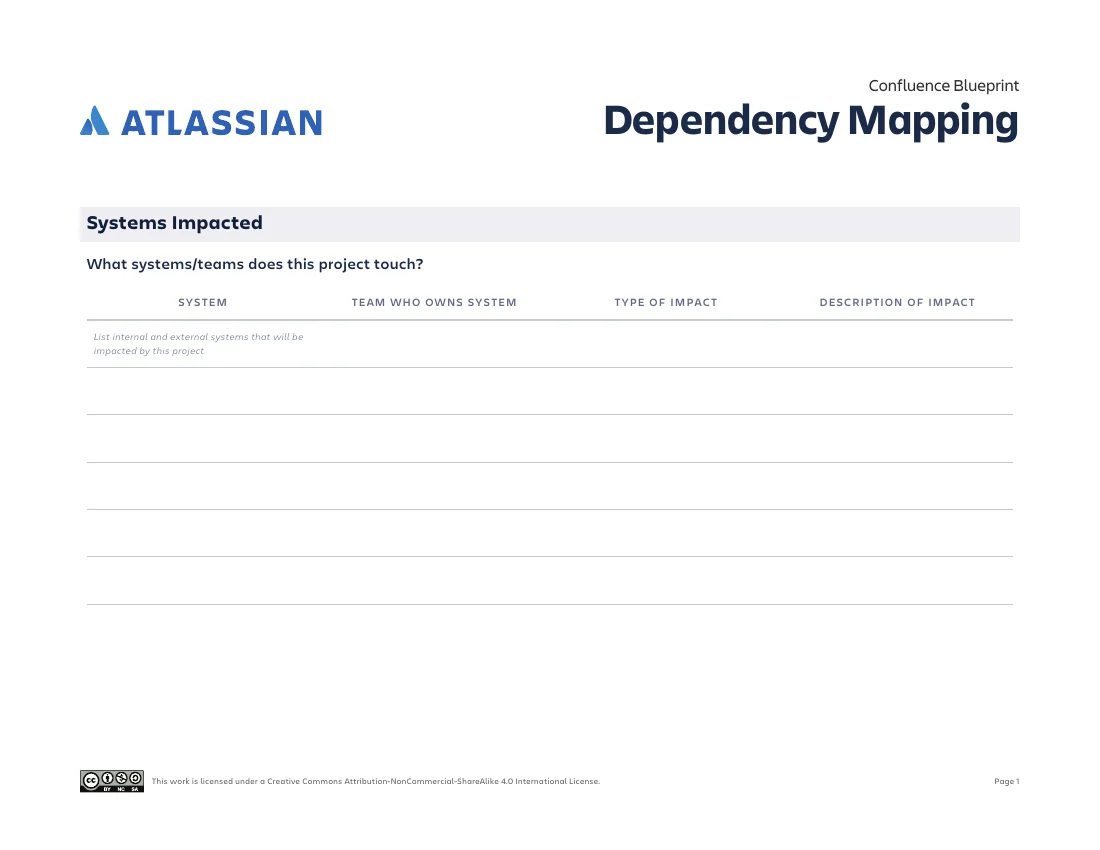
Dependency Mapping is for identifying what a project affects and what it relies on. Atlassian's worksheet connects affected systems with risks, mitigation owners and feedback arrangements.
Use it when the immediate team can finish its tasks but still needs something from elsewhere. An onboarding change might depend on a billing step owned by another group. Record what is needed, who will discuss it with that group and when the teams will review it. The map is an account of dependencies to manage; it does not prove the other group has accepted a date or supplied the required work.

7. Network of Teams
Network of Teams is for mapping the teams around a shared goal and how those relationships work. The play identifies their influence, assigns relationship owners and can assess the health of the connections.
Choose it when the problem is reaching and coordinating the right groups, rather than listing individual dependencies. For the onboarding project, a support team might hold customer feedback while an operations team controls a delivery step. A relationship owner has someone to keep informed and consult. That role differs from owning the other team's work, and a favourable relationship rating does not establish agreement on the project.
8. Premortem
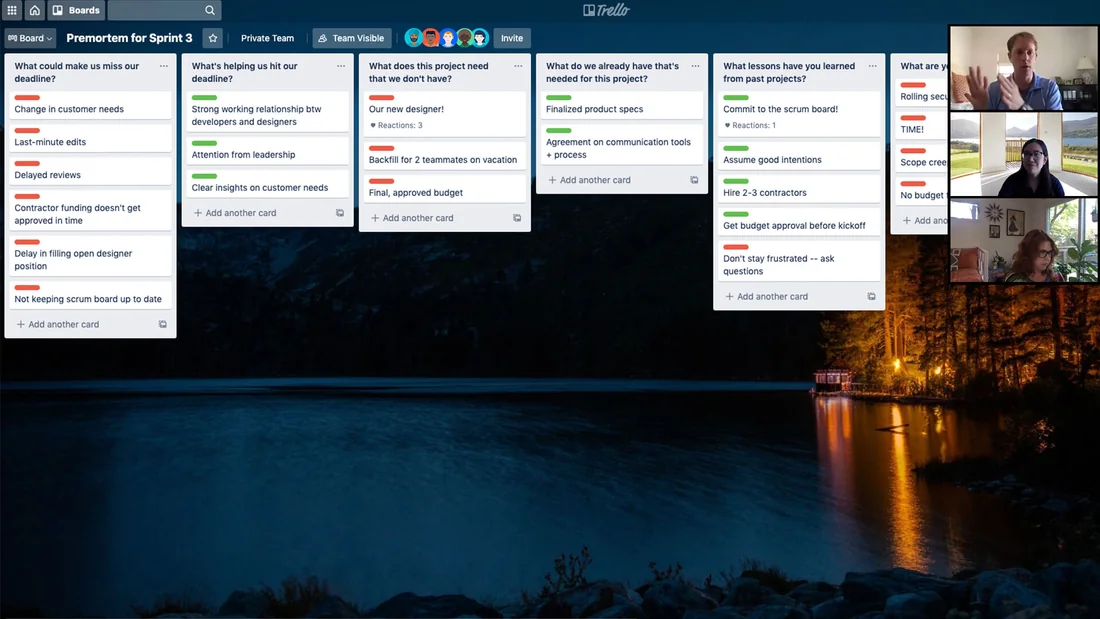
Premortem is for discussing what could help or derail a project before it happens. Atlassian's exercise asks participants to generate ideas individually, group them and choose topics for discussion, ending with actions, owners and deadlines.
Use it when an apparently settled plan leaves concerns unspoken. In the hypothetical project, the group could ask what would prevent customers from using the new onboarding guidance even if it is delivered on time. Voting helps choose what to discuss; it does not measure the probability of a risk. The useful result is a response someone can carry out, with the uncertainty still visible.

9. Project Trade-Off Analysis
Project Trade-Off Analysis is for agreeing which constraints can move when a project cannot satisfy them all. The guide asks the team to rate the flexibility of variables such as cost, scope, quality, time and risk, then discuss the differences.
It fits the onboarding group when the planned release date and the desired scope compete for the same capacity. Ask what can change and who can authorise that change. A team's preference for a flexible deadline does not alter a promise already made to a customer. Bring the relevant commitment into the discussion before treating the rating as a decision.

10. Retrospective
Retrospective is for reviewing completed work and agreeing what to improve next. Atlassian's current guide is framed around sprints, collecting feedback on what went well and what did not, and turning that feedback into action.
For a cross-team project outside a sprint process, adapt the review to a completed stage with a clear beginning and end. The onboarding group could compare what happened with the responsibilities and dependencies it recorded earlier. Separate an observed missed handoff from an explanation that still needs checking. The review is useful only if the team can act on what it learns; it does not establish that a new software tool or a different meeting will solve the problem.
For a live cross-team problem, start with the decision, the people holding the relevant information and the result the work needs to produce. Those are also useful starting points for a bounded consulting assignment. If participation in the conversation is the difficulty, the Liberating Structures for sales-team discussions offer a different set of formats.
Sources
- Project Poster
- Project Kickoff
- Roles and Responsibilities
- DACI
- Working Agreements
- Dependency Mapping
- Network of Teams
- Premortem
- Project Trade-Off Analysis
- Retrospective
Sources checked on 15 November 2026.