Which customers should get your next pilot?
A shorter demo can fill the pipeline faster than the team can run the trials.

When two customers are ready for a pilot, compare what each would lose by waiting and the work each requires from your team. Give the next slot to a pilot that can inform a consequential customer decision in time, provided both teams can do the required work.
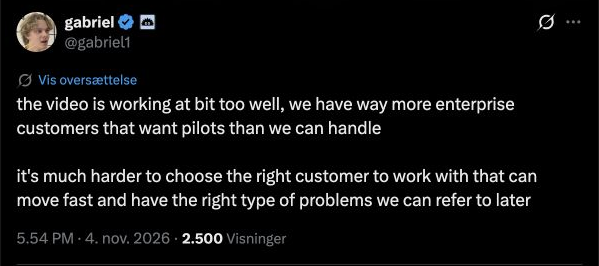
Gabriel says he can put a long pitch into a short demo video and then take questions.

In a follow-up, he says he has received more pilot requests than his team can handle. He wants customers who can move quickly and have problems the team can refer to later. That is his account of demand and his selection priorities. He does not describe completed pilot results in either post.
What can the customer decide after the pilot?
A useful pilot has an outcome that someone on the customer's side can act on. In the [Proof of Value approach](/articles/what-is-a-proof-of-value/), the Sales Engineer leads the proof while the account executive runs the commercial path around it. Here that division helps compare requests competing for the same weeks of support.
Consider a hypothetical seller with 12 Sales Engineering hours available for pilots starting next week. Two companies want to test an AI proposal tool. Both have a sales manager to judge proposal quality and a sales director who will decide whether to fund a rollout. Each has confirmed which proposal material may be used in the named pilot workspace and AI tool, including the data restrictions that apply.
At the first company, a salesperson will prepare a draft from an agreed customer brief. The manager will check whether it answers that brief and trace its claims to the supplied material. The team will compare preparation and correction time with its current process on the same agreed brief. In this invented test, the director sets a threshold of at least 20 percent less total time, with all required sections present and every factual claim supported by the supplied material. These are the hypothetical buyer’s criteria for this task. The result would inform its next investment decision, while performance across its other proposals would remain to be tested. The director wants to decide whether the tool reduces the work involved in producing an acceptable proposal before a renewal decision in two weeks. In this example, the director has authority for the relevant purchase, has confirmed the remaining approvals and says that missing the decision would mean keeping the current system for another year.
The second company wants to answer the same buying question. It can provide permitted sample material and a ready test workspace. Its director has a later review date and can wait. The second pilot needs an estimated two hours of seller preparation and three of support. The first needs a separate workspace, estimated at eight preparation hours and four support hours. Running both next week would require 17 hours against the 12 available.
A [Proof of Value plan](/tools/proof-of-value-plan/) makes the result and review explicit for each buyer. Both requests can pass that test. The remaining choice is how to spend the seller's constrained time.
Which commitment can the team support now?
Compare the buyer's decision date and the cost of waiting with the seller effort needed to reach it. In this example, the first company's renewal makes delay consequential. The second request is easier to deliver but can wait.
Suppose the first company's director confirms that the pilot review and the remaining purchasing approvals can finish before the renewal decision. The Sales Engineering manager confirms that the eight preparation hours are available before the customer starts and that four support hours are available during the test. The seller can give it the next slot, agree a later slot with the second buyer, subject to both teams confirming availability, and state the reason to both account teams. That choice spends more preparation time to inform the earlier decision. It depends on the preparation fitting the team’s available hours and on the first buyer keeping its agreed review date.
Now replace the first buyer’s material agreement with a different answer. If that buyer says it cannot provide its permitted material until too late for the eight preparation hours to finish before the pilot starts, the test may miss the renewal decision. Ask whether a narrower test could still answer the agreed buying question in time. If it cannot, offer the slot to the second buyer, confirm it can use that start date and explain what would need to be ready before the first can start.
Write those conditions beside the decision. The account executive owns confirming the buyer's timing and authority. The Sales Engineer estimates preparation and support and flags what the test needs from the customer's environment. An enthusiastic request without a defined buying decision goes back into discovery before this comparison.
What would a useful reference demonstrate?
A useful reference describes an outcome another buyer can assess. Gabriel's interest in referenceable problems raises a further question for the seller. Which part of this customer's result would help someone else decide?
A familiar company name may help get attention. The account team still needs to understand the task, the starting conditions and what the customer found. A result from a setting that other customers cannot reproduce may be difficult to use in later conversations.
Talk about any proposed reference with the customer. Participation in a pilot gives the seller no basis to promise a public case study. The customer's permission, the result and what can be disclosed remain decisions to settle.
For each pilot request, the account executive and Sales Engineer can keep a short comparison. Write down the customer decision and who will judge it, the agreed result, the people and permitted material available, the seller effort and the review date. For an unknown, name who will confirm it and by when. Keep it out of the comparison of confirmed advantages until the answer arrives. Then decide whether to reserve the slot, narrow the question or defer the request. [Sales Engineering advisory](/consulting/sales-engineering/) can help a team work through those choices in its opportunities.