AI marketing analytics: what caused the sale?
Connected records help explain a sale. A budget decision needs more than a confident attribution.

Joining marketing and sales data gives AI more of the customer journey to analyse. It does not, by itself, establish which campaign caused a sale or whether spending more on it would bring additional customers.
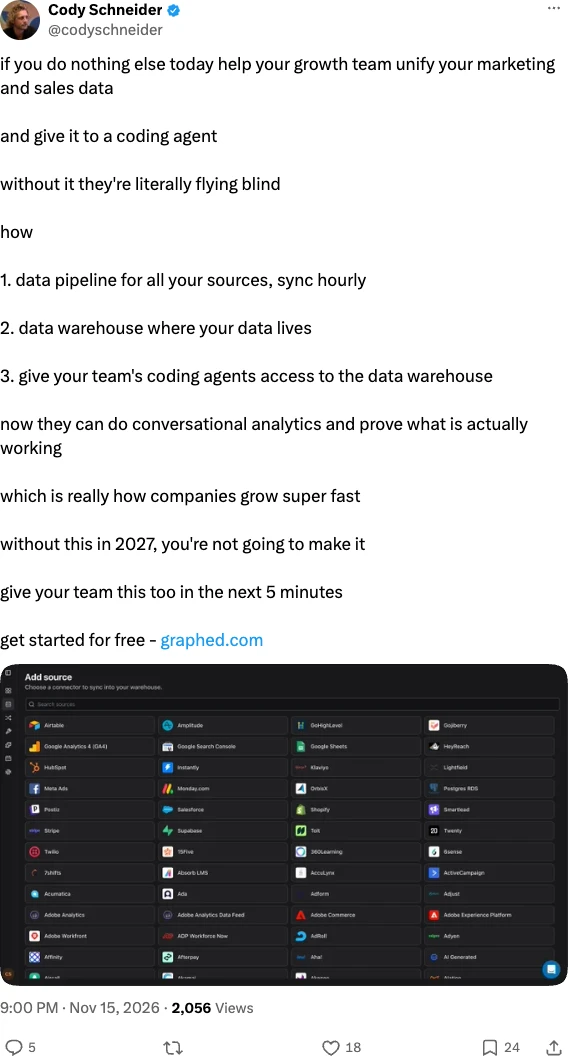
Cody Schneider argues for connecting marketing and sales data, then giving agents access so a growth team can ask what is working. His post also promotes a data product. The useful proposition is that separate records can be examined together; the stronger promise that this proves what works needs a more careful question.
What does a marketing conversion actually count?
Start with the event each system records, rather than treating every conversion as a completed sale. An enquiry, a registration, a signed agreement and a payment describe different steps.
Take a hypothetical company selling a paid workshop. A person sees an advert, registers through the website, receives a follow-up email and later pays an invoice. The advertising platform might report a conversion at registration. The CRM might record a won opportunity after the booking is confirmed. The invoice system records a payment. Those records can describe the same journey without measuring the same outcome.
Before asking AI to compare campaigns, have the people who use those systems agree what the decision concerns. If it is about paid workshop bookings, specify the period, the relevant booking and payment records, and how cancellations are handled. Keep registrations visible as an earlier step. Relabelling them as customers would hide the question the company is trying to answer.
Matching the records also needs a defensible connection between them. If a booking cannot be matched to the enquiry that preceded it, leave that part of the journey unknown. A plausible explanation generated by AI cannot supply the missing record.
Which campaign gets credit for a customer?
Credit depends on the attribution rule. A rule can help allocate reported results consistently, but it does not reveal what the customer would have done without the campaign. Google describes attribution as assigning credit along the path to an action; the definition is about how credit is allocated.
In the workshop example, the advert may receive credit for introducing the person, while the follow-up email receives credit for the final visit before payment. If both reports claim the booking, adding their credited conversions would count the same booking twice. Ask AI to show the underlying booking and the rule used for each claim, instead of combining the totals into a larger success story.
Keep the company's own record of the paid booking separate from the way a platform attributes it. The team can then discuss the same sale while acknowledging that the reports answer different questions. A last-touch view may be useful for reviewing the final step; it does not show that earlier contact was unnecessary.
Nor does a joined journey settle causation. The person might already have intended to attend, or a colleague might have recommended the workshop outside the recorded channels. Those possibilities do not prove the campaign failed. They limit what its recorded connection to the sale can establish.
What would justify changing the marketing budget?
Tie the budget decision to the uncertainty that remains. More complete reporting can justify investigating a campaign without yet justifying a large spending increase.
For the hypothetical workshop, the owner could first check whether attributed registrations became paid bookings and whether the recorded income covers the costs relevant to the decision. If the remaining question is whether the advert brings additional bookings, design a comparison that can address that question. For example, a suitable group might receive the campaign while a comparable group does not. How groups are chosen, what else changes and how many bookings are observed affect what the comparison can support. Google’s Conversion Lift explanation illustrates the exposed-group and control-group approach; its product is not available to every account.
Where such a comparison is not practical, state that limitation and keep the decision proportionate. A limited, monitored budget change can be a way to learn. It should have an agreed spending limit, a booking outcome to watch and a date to review it. A small or inconclusive result remains a reason to investigate, rather than a general growth claim.
Giving an agent access to these records also raises separate questions about information and authority. The company's AI acceptable-use decisions should cover the approved tool and data. Permission to analyse a campaign does not itself permit changing its budget. Where a recommendation goes to leadership, the AI-assisted decision memo should show the sources, assumptions and person who owns the decision.
Connected data can help the team trace a booking, reconcile conflicting reports and ask a better commercial question. The answer should distinguish what was recorded, how credit was assigned and what remains unknown about additional sales. That gives the owner a basis for deciding what to test next.