What does a verified revenue label promise a buyer?
When a revenue leaderboard becomes a marketplace, the same verified number supports a bigger decision. Buyers need to know exactly what was checked.

A revenue-verification badge can identify the source of a figure without establishing profitability, ownership or contracts. Before relying on it to buy a business, check which claims the marketplace has verified and which it leaves to the parties.
Marc Lou describes how TrustMRR started as a revenue leaderboard and became a startup marketplace after users asked for it. He calls it his "anti-AI asset" and argues that trust and an audience of buyers cannot be vibe-coded. The move from leaderboard to marketplace matters because it changes what people use the information to decide.
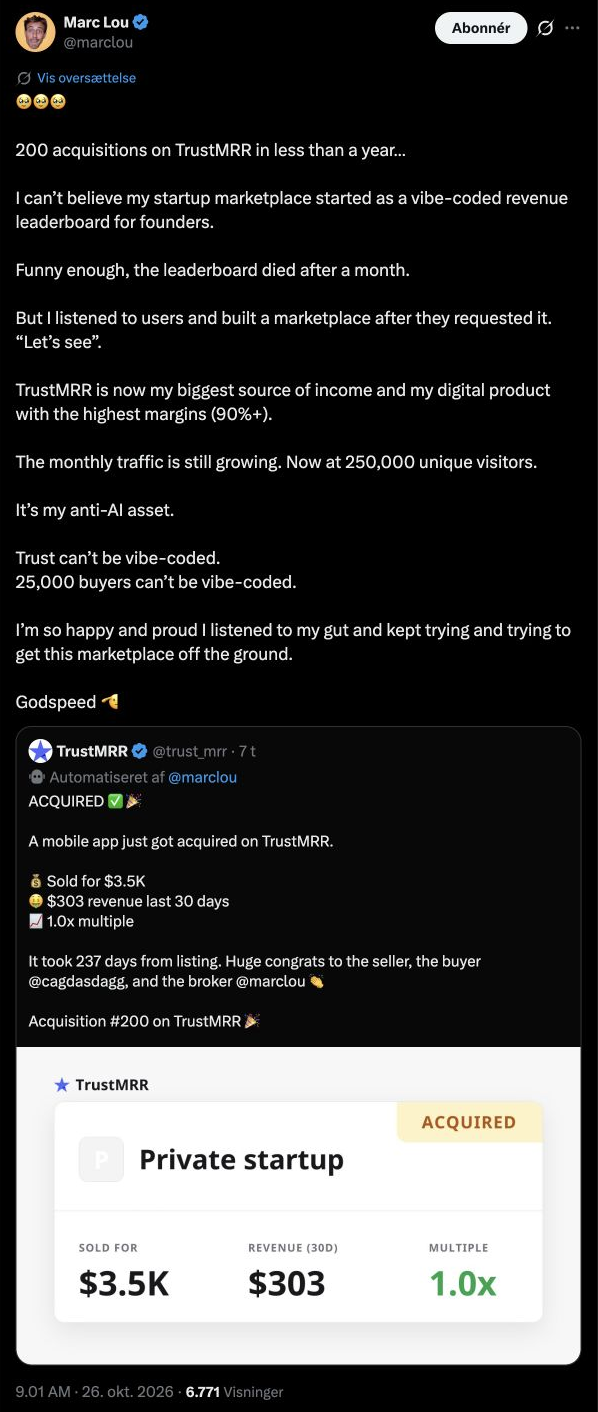
On a leaderboard, a visitor may simply be curious about how another founder's product is doing. On a marketplace, the same revenue figure can decide whether they contact the seller and investigate a purchase. The number can come from the same source in both places, while the consequences of relying on it become much larger.
What TrustMRR verifies, and what it leaves to the buyer
TrustMRR verifies revenue through connections to payment providers. Its FAQ says it reconstructs metrics from transaction data and warns that discrepancies of up to 30% can occur, depending on the provider. A buyer needs to understand that calculation before treating the displayed figure as equivalent to the provider's dashboard.
The marketplace terms put independent due diligence on the buyer and seller. They also say the platform does not verify information those users provide, including financial claims, ownership and contracts. Read next to the FAQ, that means a buyer can meet several kinds of claim on one listing, each with different evidence behind it.
How should a listing show what was verified?
Each figure should show where it came from. Which information comes directly from a connected provider? Which fields has the seller entered? Does a calculation use a definition the buyer can understand? Those differences need to be clear on the listing, before the buyer has to search the terms.
Take a hypothetical listing with a connected revenue figure and a profit margin supplied by the seller. Both numbers may matter, but the evidence behind them is different. One verification badge beside the whole listing could leave a buyer unsure which claims it covers. A source and scope attached to each figure lets the buyer see what still needs checking.

How do you find out what buyers think was checked?
Ask someone considering a purchase to explain what they believe the platform has checked, and listen before explaining what the label is meant to say. If their account includes profitability or ownership that the platform has not checked, the team has a product problem to fix, however accurate the terms are.
Who handles a disputed figure?
A disputed figure needs an owner. Suppose a buyer challenges a figure after contacting a seller: who looks into it, what can that person inspect, and what happens to the listing while the disagreement is open? The founder needs an answer the team can carry out, including where the issue goes if the buyer and seller still disagree.
Narrow verification or broader checks?
A narrow promise can be a sensible choice. A marketplace might establish where a revenue figure came from and leave the wider assessment to the parties. That works when the scope is useful and understood, and when buyers get enough supporting information to do the work the platform leaves to them.

Offering broader verification is a different business commitment. Checking more claims takes work, especially where records disagree or an answer needs judgement. Before selling that reassurance, work out what the check involves, who can do it and how the difficult cases affect the economics.
AI does not settle what a public claim can rest on. It can help build a marketplace, connect its systems and check information. The founder still has to decide what evidence supports a public claim and what the company will do when that claim is challenged. That work continues after the feature ships, and how it is handled can give customers a reason to keep using the service.
How to test your own verified label
Marc's post does not show how TrustMRR's buyers read its verification; only the buyers can say. It does give any business adding more consequential uses to its product a useful question: has the customer's reliance grown beyond the promise the company is equipped to deliver?
For a product that already uses "verified", pick one claim a customer relies on and follow it through the actual decision. If the customer expects an ownership check and the product only connects a payment account, the team has a concrete choice. It can explain the narrower scope clearly, or work out how to provide the additional check and charge enough to do it properly.