AI agents and SaaS switching costs
A cheaper offer is a reason to investigate a switch. The work still has to move.

AI agents could make software prices easier to compare while leaving a business with work to do before it can change suppliers. The saving depends on whether the replacement can carry the company's working process and what it costs to move that process.
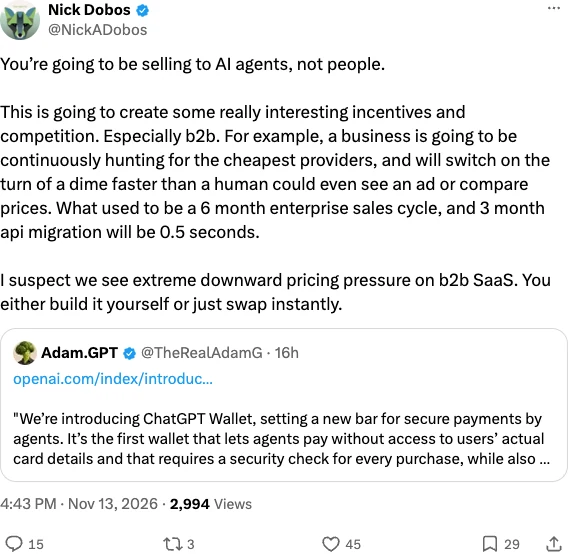
Nick Dobos predicts rapid switching between software suppliers as agents hunt for cheaper providers. He expects downward pressure on B2B software prices and imagines enterprise sales and migration happening in half a second. That is a prediction. It leaves a useful question for a business owner: what would have to be interchangeable for the switch to be that easy?
What has to move when you change software?
The replacement needs to support the work the business relies on, including the unfinished work already in progress. Comparing the subscription prices gives only part of the buying decision.
Take a hypothetical service company choosing a cheaper system for handling customer requests. Its current system holds open cases, the person responsible for each case and promises already made to customers. A replacement that can store the same fields still needs to preserve their meaning. An imported due date is useful only if the next person understands what was promised and who must act.
Follow an open case through the proposed move. Can the person taking over see why it is waiting? Can they find the customer's last answer? What happens to an action scheduled for tomorrow? These questions test whether the work can continue after the data arrives. They do not require the buyer to design the migration.
A company assessing a supplier can make this part of its proof of value. Agree which case the replacement must carry and what the people doing the work need to demonstrate. The test should answer a buying question, such as whether the team can resume its open cases without rebuilding their history by hand.
When does a cheaper subscription become a saving?
A lower recurring fee becomes a business saving after allowing for the work and charges required to make the change. The comparison needs a period over which the buyer expects to use the replacement.
In the service-company example, the owner would need an estimate for moving the cases, checking them and helping the team use the new system. If both subscriptions have to run during that work, include the overlap. A fee that cannot yet be cancelled remains payable even when people stop using the product.
Keep an estimate of staff time separate from cash the company will actually avoid spending. The team might finish the move within its existing hours, postponing other work. That is a cost to the business, but it is different from an extra invoice. The distinction also matters when counting AI cost savings.
The comparison can still favour the cheaper supplier. The point is to show when it does. If the change pays for itself only after the business expects to replace the system again, the headline subscription discount gives a misleading reason to proceed.
What should a software supplier be able to prove?
A supplier should be able to explain which work its price covers and help the buyer test whether that work survives a move. A claim that migration is easy becomes more useful when the buyer can see an existing case continue in the replacement.
For the hypothetical company, a sales conversation could start with an open request and the people who need to act on it. The supplier can then show what transfers, what requires a decision and what still needs manual work. This gives the buyer something to compare beyond a list of matching features.
Dobos's prediction becomes more plausible where the buyer can test and move the work with little disruption. Where that has not been demonstrated, an agent finding the lowest price has found a candidate for evaluation. The owner still needs an answer to the practical question: what happens to the work already underway on the day the company switches?