How to turn sales calls into public content
Deleting the customer’s name may still leave enough detail for someone to recognise them.
A question from a sales call can become an article when the answer will help other buyers in the same situation. Develop that answer using public sources or a clearly labelled example.
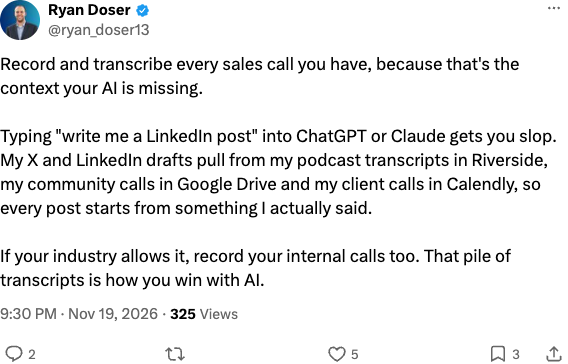
Ryan Doser describes using transcripts to draft social posts. His drafts draw on podcasts, community calls and client calls. It makes sense to start with a real question. A buyer on a sales call is choosing what to tell you so you can help with their decision. Writing for an audience calls for a second decision about which material you can use.
Which part of a sales call can become an article?
Take the question a second buyer could ask in a different company. Keep the people, dates and choices specific to the original conversation in the account.
Suppose a buyer asks how to test new software when the staff needed for the pilot are already committed to a rollout. Their rollout date and their disagreement about who can spare a tester explain why it matters to them. A public article can answer a question another buyer might recognise: how do you plan a software pilot when the people who need to test it are already booked?

Start the answer with the decision that depends on the pilot. If it is whether analysts can use the software to do their weekly reporting, a vendor demo can show what to ask about, but analysts need time to try the work before the buyer has evidence that they can do it. The buyer can decide whether to narrow what the pilot needs to prove or wait until people can take part.
A writer or an AI assistant can start with the general question, material cleared for public use and the decision the reader needs to make. Make that brief before sharing anything with the writing tool. If the original call is the only support for a detail, replace it with public evidence or use a clearly labelled fictional example. A fictional pilot can show what the analysts would need to try without relying on the buyer’s actual rollout plan.
What should you check before publishing?
Read the draft as someone who was on the call. Look for details that could identify the buyer when read together, and for lines that make a question sound like an endorsement.
An unnamed company can still be easy to recognise if the article describes a particular industry, a release date and a team struggling to staff the test. Check the headline and examples as well as the quotations. If the recognisable detail is essential to the piece, ask for permission to use that specific passage in public. Permission to record a call for the account does not by itself grant permission to publish what somebody said.

Then read it as a buyer you have never spoken with. Could they use the article to make a choice? In the pilot example, they can ask which decision the test will inform and when the people needed to do the work are available. If the draft only says that busy teams find pilots difficult, it still needs an answer.