AI assistant notifications: what needs your attention?
Judge an assistant by the decisions its alerts help you make, including the important change it might miss.

An AI assistant earns an interruption when it brings a change you need to act on. Several assistants reporting the same unchanged task give you more messages to read without adding a decision.
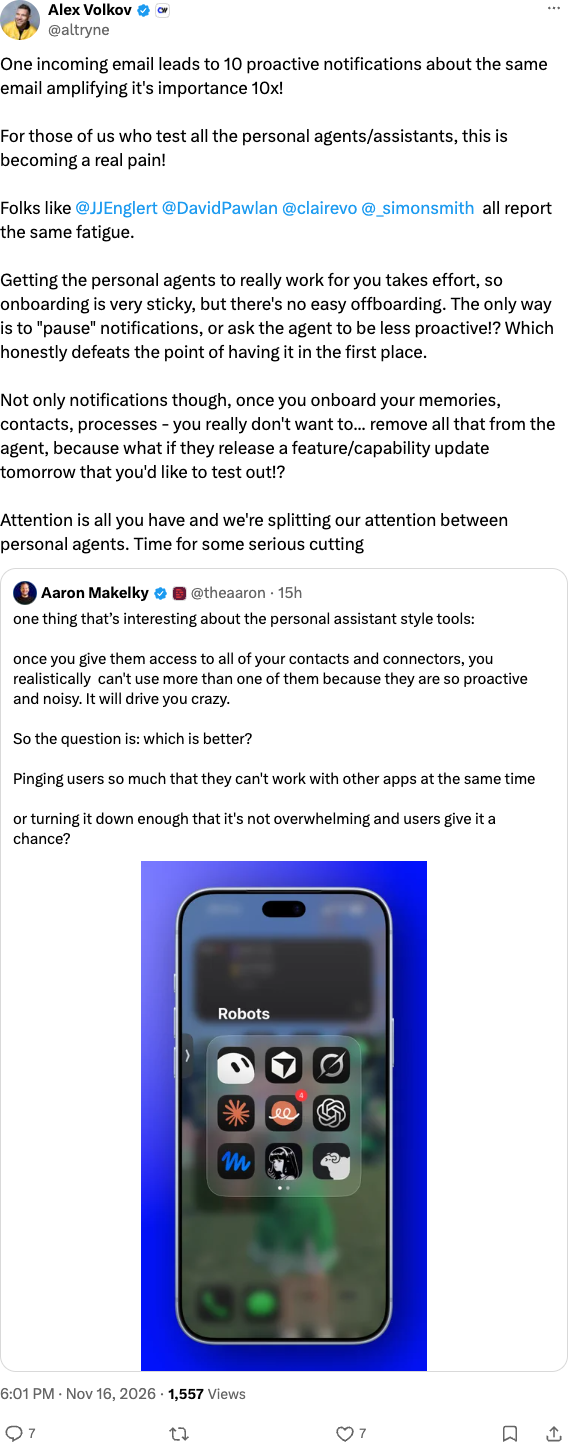
Alex Volkov describes repeated notifications from personal AI assistants about the same incoming email. He also describes the reluctance to leave assistants after investing effort in their context and setup. This is his account of trying tools, not a measured notification rate across the market. It raises a useful question for a business owner: what would make the next alert worth opening?
Which AI notifications need an immediate response?
An immediate alert needs a reason waiting would change what you can do. A progress report can usually join a later update if it leaves the next decision unchanged.
Take a hypothetical owner preparing a client workshop. An assistant is watching for confirmation of the room. Another is assembling the workshop brief. If both announce that the client's email has arrived, the owner still has the same message to read. Calling it urgent twice does not move the workshop deadline.
The useful distinction is what the email changes. A confirmed room may simply complete a task. A rejected booking close to the agreed decision time could require the owner to choose another venue. The alert should identify the workshop, what changed, when a decision is needed and the original message. That lets the owner judge the consequence rather than trust an unexplained urgency label.
Agree those conditions before relying on the assistant. For this workshop, the owner might want an immediate interruption for a cancellation or an unresolved room choice at the agreed cutoff. Routine preparation could appear in a scheduled summary. These are choices about this commitment, not universal settings for every business. A time-sensitive client message still needs a reliable route to a person.
How can several assistants report on the same task?
Give the task a shared record and make clear who reports the next change. The record needs to let people recognise the same workshop even when different assistants describe it differently.
In the hypothetical example, keep the client's original room email with the workshop's date and current booking status. The assistant assembling the brief can use that record without creating a second request for the owner to confirm the room. If it cannot reliably use the same record, treat it as a separate experiment rather than assuming the tools coordinate.
Combining updates also needs judgement. A later email correcting the date is new information, even if its subject line matches the confirmation. Suppressing it as a duplicate would hide the change the owner needs. Group messages by the underlying task, but preserve a correction, a changed deadline or contradictory information for review.
A notification is also different from the work it reports. A message saying the room is confirmed should lead to the client's confirmation or the booking record. If the assistant has only prepared an enquiry, the room remains unconfirmed. Where the update asks for a decision, an AI-assisted decision memo can preserve the recommendation and the uncertainty behind it.
How do you know a quieter assistant still works?
Check whether the assistant brings important changes to the right person in time. Fewer alerts alone cannot tell you whether it has stopped repeating itself or stopped checking.
For the workshop, try a routine confirmation, a cancellation and a correction to the date in an authorised test setup. Agree beforehand what the owner should receive for each. Record whether the alert appeared, whether it pointed to the right source and whether the owner could tell what needed doing. A case that never reaches the owner is a failure to investigate, even if the inbox looks wonderfully calm.
Keep the existing manual check while trying the arrangement. A small test can reveal a missed change; passing those cases does not establish that the assistant will catch every future problem. Review an actual workshop afterwards, including any repeated alerts and any important message found through another route. Change the reporting conditions where the evidence calls for it.
If the owner decides to stop using an assistant, check which responsibilities still depend on it before removing its access. Transfer the room check to a named person or another tested arrangement, and retain the records the business needs. Volkov's point about setup effort matters here: time spent teaching a tool is a reason to plan the handover, not proof that it deserves another place in the working day.
The owner can then judge the arrangement against the commitment: did the room get confirmed, did a change reach someone who could act, and how much checking remained? Agreed response windows address the related promise to clients. The assistant's internal updates should help keep that promise without making the owner review the same unchanged task repeatedly.